Welcome to Substance Misuse Limestone Coast
Substance Misuse Limestone Coast is a group of professionals working to facilitate community based solutions to address issues arising from drug and alcohol use across the Limestone Coast.
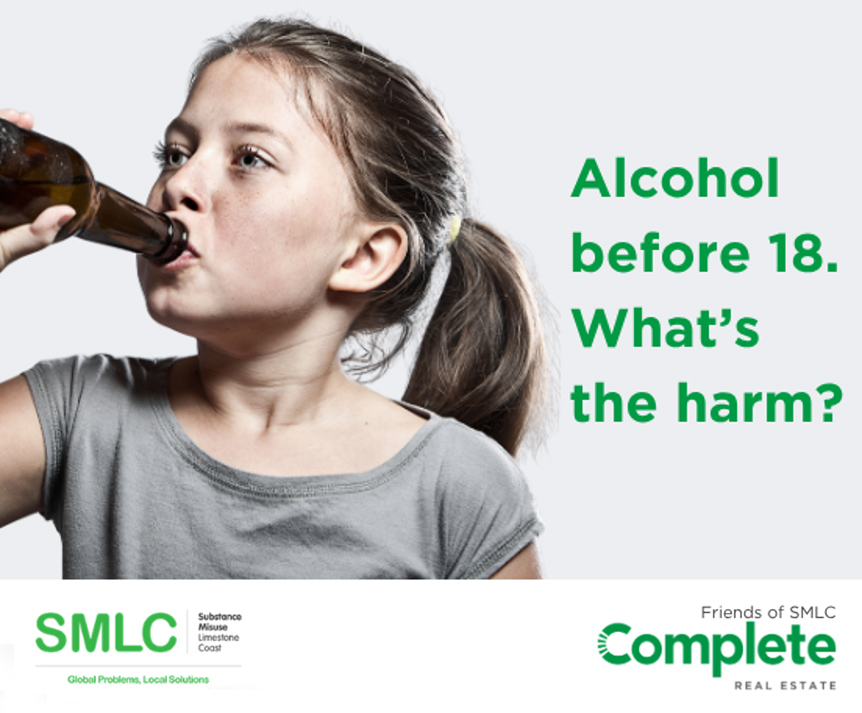
Do you know?
Adolescent brains are more sensitive to alcohol. Drinking in adolescence can be harmful to a young person’s physical development, particularly brain development. Alcohol consumption during adolescence can bring about learning difficulties, memory and social problems.
As a parent what can you do?
There is no evidence to support the view that parental supply of alcohol protects children, in fact it is the opposite and parental supply is seen as a permissive culture for alcohol use. Take action by:
- Getting to know the parents of your children’s friends;
- Gather with other parents to discuss the idea of working together and agreeing on.
- Making a commitment to not allowing teenage children to drink alcohol. Anywhere.
- Be a collective voice for communicating about the importance of not allowing your children or your children’s friends to drink alcohol. Anywhere. Anytime.
Key Fact
People who first drink alcohol before age 15 are five times more likely to drink more alcohol than those who first used at age 18 or older.
Full Brain Development
Different parts of the brain develop at different rates as we grow. Rational thinking in the pre-frontal cortex does not fully develop until 25 years old. Alcohol use during its development can have lifelong consequences for a young person’s memory, personality and behaviour.
Risks
Drinking alcohol in adolescence can cause permanent irreparable damage with memory loss, inability to learn, problems with verbal skills, alcohol dependence and depression. It’s really helpful for young people to be supported to not drink any alcohol until after they turn eighteen.
SMLC provides leadership in highlighting alcohol and other drug issues as health issues by delivering evidence-based services to reduce harm and improve individual well-being and community outcomes.
SMLC collaborates with our community to understand and promote local solutions for global problems, using national and international best practice resources.
SMLC are not a treatment service, however we advocate for and collaborate with local drug and alcohol treatment services.
To find the right service for your needs, please visit our Services page.

Media Releases
OurFutures AOD education boost across Limestone Coast schools
October 22, 2026
Limestone Coast secondary school children are now receiving vital alcohol and other drug (AOD) education after a strong uptake in local schools…
Proactive AOD education opportunity across Limestone Coast
March 02, 2026
Limestone Coast schools are being offered the opportunity to add award-winning alcohol and other drug (AOD) prevention programs into their…
Additional youth services needed - Limestone Coast AOD Regional Summit 2025
December 02, 2025
A need for more specialised youth drug and alcohol services has been a key point of discussion at Substance Misuse Limestone Coast’s (SMLC)…
Friends & Supporters of SMLC